Algebra I Fundamentals – Unit 6 Semester Review and Exam Exam
Boolean algebra is the category of algebra in which the variable's values are the truth values, truthful and false, ordina rily denoted i and 0 respectively. It is used to analyze and simplify digital circuits or digital gates . It is also ca lled Bi nary Algebra or logical Algebra . It has been key in the development of digital electronics and is provided for in all modern programming languages. It is also used in set theory and statistics.
The important operations performed in boolean algebra are – conjunction (∧), disjunction (∨) and negation (¬). Hence, this algebra is far way different from unproblematic algebra where the values of variables are numerical and arithmetic operations like addition, subtraction is been performed on them.
Table of contents:
- Operations
- Terminologies
- Truth Table
- Rules
- Laws
- Theorems
- Example
- FAQs
Boolean Algebra Operations
The basic operations of Boolean algebra are as follows:
- Conjunction or AND functioning
- Disjunction or OR operation
- Negation or Not operation
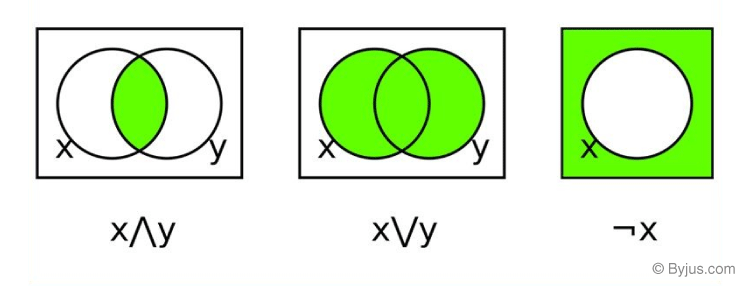
Below is the table defining the symbols for all three bones operations.
| Operator | Symbol | Precedence |
| NOT | ' (or) ¬ | Highest |
| AND | . (or) ∧ | Middle |
| OR | + (or) ∨ | Lowest |
Suppose A and B are 2 boolean variables, so we can define the iii operations as;
- A conjunction B or A AND B, satisfies A ∧ B = True, if A = B = True or else A ∧ B = False.
- A disjunction B or A OR B, satisfies A ∨ B = Simulated, if A = B = False, else A ∨ B = True.
- Negation A or ¬A satisfies ¬A = Simulated, if A = True and ¬A = True if A = Fake
Boolean Expression
A logical statement that results in a boolean value, either be True or False, is a boolean expression. Sometimes, synonyms are used to limited the statement such every bit 'Yes' for 'True' and 'No' for 'False'. Too, 1 and 0 are used for digital circuits for True and False, respectively.
Boolean expressions are the statements that use logical operators, i.e., AND, OR, XOR and Not. Thus, if we write X AND Y = Truthful, then information technology is a boolean expression.
Boolean Algebra Terminologies
Now, let us discuss the of import terminologies covered in Boolean algebra.
Boolean Algebra : Boolean algebra is the co-operative of algebra that deals with logical operations and binary variables.
Boolean Variables: A boolean variable is defined as a variable or a symbol defined equally a variable or a symbol, generally an alphabet that represents the logical quantities such equally 0 or 1.
Boolean Function: A boolean function consists of binary variables, logical operators, constants such every bit 0 and 1, equal to the operator, and the parenthesis symbols.
Literal: A literal may be a variable or a complement of a variable.
Complement : The complement is divers equally the changed of a variable, which is represented by a bar over the variable.
Truth Table: The truth table is a tabular array that gives all the possible values of logical variables and the combination of the variables. It is possible to convert the boolean equation into a truth table. The number of rows in the truth table should be equal to 2 n , where "n" is the number of variables in the equation. For instance, if a boolean equation consists of 3 variables, so the number of rows in the truth tabular array is viii. (i.due east.,) ii 3 = viii.
Boolean Algebra Truth Tabular array
At present, if we limited the above operations in a truth table, we go;
| A | B | A ∧ B | A ∨ B |
| True | True | True | True |
| True | False | False | Truthful |
| Fake | True | Faux | True |
| False | False | False | Faux |
| A | ¬A |
| True | Fake |
| False | Truthful |
Boolean Algebra Rules
Post-obit are the of import rules used in Boolean algebra.
- Variable used can have only two values. Binary 1 for HIGH and Binary 0 for LOW.
- The complement of a variable is represented by an overbar. Thus, complement of variable B is represented as
\(\brainstorm{array}{l}\bar{B}\end{array} \)
. Thus if B = 0 then\(\begin{assortment}{l}\bar{B}\end{assortment} \)
=ane and B = i then\(\begin{array}{50}\bar{B}\terminate{array} \)
= 0. - OR-ing of the variables is represented past a plus (+) sign between them. For example OR-ing of A, B, C is represented as A + B + C.
- Logical AND-ing of the 2 or more than variable is represented past writing a dot between them such as A.B.C. Sometimes the dot may be omitted like ABC.
Laws of Boolean Algebra
In that location are six types of Boolean algebra laws. They are:
- Commutative law
- Associative constabulary
- Distributive law
- AND constabulary
- OR constabulary
- Inversion law
Those 6 laws are explained in detail hither.
Commutative Law
Whatsoever binary functioning which satisfies the post-obit expression is referred to as a commutative functioning. Commutative law states that changing the sequence of the variables does not have any effect on the output of a logic excursion.
- A. B = B. A
- A + B = B + A
Associative Law
It states that the gild in which the logic operations are performed is irrelevant as their event is the aforementioned.
- ( A. B ). C = A . ( B . C )
- ( A + B ) + C = A + ( B + C)
Distributive Law
Distributive police states the following conditions:
- A. ( B + C) = (A. B) + (A. C)
- A + (B. C) = (A + B) . ( A + C)
AND Law
These laws use the AND operation. Therefore they are called AND laws.
- A .0 = 0
- A . i = A
- A. A = A
-
\(\brainstorm{array}{fifty}A. \bar{A}= 0\end{array} \)
OR Law
These laws utilize the OR performance. Therefore they are chosen OR laws.
- A + 0 = A
- A + 1 = i
- A + A = A
-
\(\begin{array}{l}A + \bar{A}= i\end{array} \)
Inversion Police
This law uses the NOT operation. The inversion law states that double inversion of variable results in the original variable itself.
-
\(\brainstorm{array}{l}A+\bar{\bar{A}}=i\end{array} \)
Boolean Algebra Theorems
The two important theorems which are extremely used in Boolean algebra are Demorgan'south First police and De Morgan'due south second law. These 2 theorems are used to change the boolean expression. This theorem basically helps to reduce the given boolean expression in the simplified class. These two Demorgan's laws are used to change the expression from one class to another class. Now, let u.s.a. discuss these two theorems in item.
De morgan's First Law:
De morgan's First Law states that (A.B)' = A'+B'.
The outset law states that the complement of the product of the variables is equal to the sum of their individual complements of a variable.
The truth tabular array that shows the verification of Demorgan'southward Commencement law is given as follows:
| A | B | A' | B' | (A.B)' | A'+B' |
| 0 | 0 | one | 1 | 1 | 1 |
| 0 | 1 | 1 | 0 | 1 | 1 |
| 1 | 0 | 0 | 1 | ane | 1 |
| 1 | 1 | 0 | 0 | 0 | 0 |
The last two columns show that (A.B)' = A'+B'.
Hence, Demorgan'southward Starting time Law is proved.
De Morgan'due south Second Law:
De Morgan'south Second constabulary states that (A+B)' = A'. B'.
The second law states that the complement of the sum of variables is equal to the product of their private complements of a variable.
The following truth tabular array shows the proof for De Morgan's second police force.
| A | B | A' | B' | (A+B)' | A'. B' |
| 0 | 0 | i | 1 | 1 | 1 |
| 0 | 1 | 1 | 0 | 0 | 0 |
| one | 0 | 0 | 1 | 0 | 0 |
| i | i | 0 | 0 | 0 | 0 |
The last two columns show that (A+B)' = A'. B'.
Hence, Demorgan'south second law is proved.
The other theorems in boolean algebra are complementary theorem, duality theorem, transposition theorem, redundancy theorem and so on. All these theorems are used to simplify the given boolean expression. The reduced boolean expression should exist equivalent to the given boolean expression.
Solved Examples
Question:Simplify the following expression:
\(\begin{array}{l}c+\bar{BC}\end{array} \)
Solution:
Given:
\(\begin{array}{l}C+\bar{BC}\end{array} \)
According to Demorgan's police, nosotros can write the in a higher place expressions as
\(\begin{assortment}{l}C+(\bar{B}+ \bar{C})\end{assortment} \)
From Commutative law:
\(\begin{array}{l}(C+\bar{C})+ \bar{B}\end{assortment} \)
From Complement law
\(\begin{assortment}{l}1+ \bar{B}\end{array} \)
= 1Therefore,
\(\brainstorm{array}{l}C+\bar{BC} = 1\end{array} \)
Question 2: Draw a truth table for A(B+D).
Solution: Given expression A(B+D).
| A | B | D | B+D | A(B+D) |
| 0 | 0 | 0 | 0 | 0 |
| 0 | 0 | 1 | one | 0 |
| 0 | 1 | 0 | 1 | 0 |
| 0 | 1 | 1 | i | 0 |
| i | 0 | 0 | 0 | 0 |
| 1 | 0 | 1 | one | one |
| ane | 1 | 0 | ane | 1 |
| one | ane | 1 | one | ane |
Often Asked Questions on Boolean Algebra
What is meant by Boolean algebra?
In Mathematics, boolean algebra is called logical algebra consisting of binary variables that hold the values 0 or one, and logical operations.
Why exercise we use Boolean algebra?
In electrical and electronic circuits, boolean algebra is used to simplify and clarify the logical or digital circuits.
What are the three main Boolean operators?
The three important boolean operators are:
AND (Conjunction)
OR (Disjunction)
Non (Negation)
Is the value 0 represents true or false?
In boolean logic, nothing (0) represents faux and one (1) represents true. In many applications, zero is interpreted every bit false and a non-zero value is interpreted equally true.
Mention the six important laws of boolean algebra.
The vi important laws of boolean algebra are:
Commutative police
Associative law
Distributive constabulary
Inversion law
AND law
OR constabulary
Stay tuned with BYJU'Southward – The Learning App and too explore more than videos.
Source: https://byjus.com/maths/boolean-algebra/
0 Response to "Algebra I Fundamentals – Unit 6 Semester Review and Exam Exam"
Post a Comment