We Recycled More Than a Billion Pounds of Batteriesã¢â‚¬â€again
On this folio:
- The Current National Picture
- Generation
- Recycling
- Composting/Other Food Direction
- Combustion with Energy Recovery
- Landfilling
- Trends - 1960 to Today
- Generation Trends
- Recycling and Composting Trends
- Other Food Direction Trends
- Recycling, Composting and Other Food Management Trends Specific to 2015-2018
- Greenhouse Gas Benefits
The Current National Picture
EPA began collecting and reporting data on the generation and disposition of waste in the United States more than than 35 years ago. The Agency uses this information to measure out the success of materials management programs across the country and to narrate the national waste stream. These Facts and Figures are electric current through calendar year 2018.
The total generation of municipal solid waste (MSW) in 2018 was 292.4 million tons (U.S. short tons, unless specified) or iv.nine pounds per person per twenty-four hours. Of the MSW generated, approximately 69 million tons were recycled and 25 million tons were composted. Together, most 94 meg tons of MSW were recycled and composted, equivalent to a 32.1 percent recycling and composting rate. An additional 17.7 million tons of food were managed past other methods. Other food management includes the following management pathways: animal feed, bio-based materials/biochemical processing, co-digestion/anaerobic digestion, donation, state application and sewer/wastewater treatment. For more than information on nutrient management, come across Nutrient: Textile-Specific Information. In addition, nearly 35 million tons of MSW (11.viii percent) were combusted with energy recovery and more than 146 one thousand thousand tons of MSW (l percent) were landfilled.
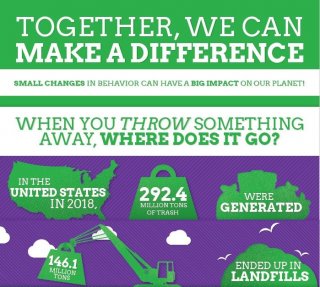
EPA refers to trash, or MSW, as various items consumers throw away after they are used. These items include bottles and corrugated boxes, nutrient, grass clippings, sofas, computers, tires and refrigerators. However, MSW does not include everything that may exist landfilled at the local level, such as construction and demolition (C&D) debris, municipal wastewater sludge, and other not-hazardous industrial wastes. While the analysis in Facts and Figures focuses primarily on MSW, EPA has been including estimates of C&D generation and management as a dissever non-chancy waste stream in recent years.
*MSW generation rose considerably from 2017 to 2018 mainly because EPA enhanced its nutrient measurement methodology to more fully account for all the ways wasted nutrient is managed throughout the food organization.
Management of MSW continues to exist a loftier priority for land and local governments. This includes the source reduction of wastes before they enter the waste stream and the recovery of generated waste material for recycling, composting or other methods. It as well includes environmentally sound waste matter management through combustion with energy recovery and conversion, as well as landfilling practices that run across current standards or newly emerging waste material conversion technologies.
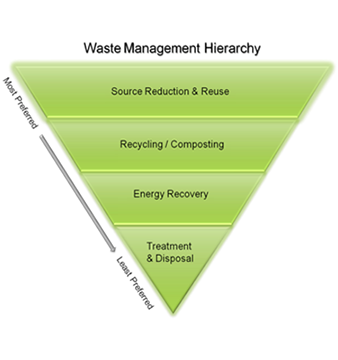
EPA developed the non-chancy materials and waste material direction hierarchy in recognition that no unmarried waste direction approach is suitable for managing all materials and waste streams in all circumstances. The hierarchy ranks the various management strategies from most to to the lowest degree environmentally preferred. The hierarchy places emphasis on reducing, reusing, and recycling equally key to sustainable materials management.
Generation
The full generation of MSW in 2018 was 292.4 one thousand thousand tons, which was approximately 23.7 million tons more than the amount generated in 2017. This is an increase from the 268.7 million tons generated in 2017 and the 208.3 million tons in 1990.
*MSW generation rose considerably from 2017 to 2018 mainly considering EPA enhanced its nutrient measurement methodology to more fully account for all the means wasted food is managed throughout the nutrient organisation.
Municipal Solid Waste Management: 1960-2018
Per capita MSW generation increased from 4.5 pounds per person per day in 2017 to 4.9 pounds per person per 24-hour interval in 2018. The increase from 2017 to 2018 is mainly the result of EPA's inclusion of additional wasted food management pathways. Encounter Food: Material-Specific Data.
Paper and paperboard products made up the largest percentage of all the materials in MSW, at 23.ane percent of full generation. Generation of paper and paperboard products declined from 87.7 million tons in 2000 to 67.4 million tons in 2018. Generation of newspapers has been declining since 2000, and this tendency is expected to continue, partly due to decreased page size, but mainly due to the increased digitization of news. The generation of part-blazon (high grade) papers also has been in turn down, due at to the lowest degree partially to activities such equally the increased use of the electronic transmission of reports. Paper and paperboard products have ranged between 28.4 and 23.1 percent of generation since 2010.
Food waste material comprised the 4th largest material category, estimated at 63.1 1000000 tons or 21.6 percent of total generation in 2018. K trimmings comprised the side by side largest cloth category, estimated at 35.four million tons, or 12.1 pct of total generation, in 2018. This compares to 35 million tons (sixteen.8 percent of total generation) in 1990. The pass up in grand trimmings generation since 1990 is largely due to land legislation discouraging yard trimmings disposal in landfills, including source reduction measures such as backyard composting and leaving grass trimmings on the yard.
In 2018, plastic products generation was 35.7 million tons, or 12.ii percent of generation. This was an increase of iv.three meg tons from 2010 to 2018, and it came from durable goods and the containers and packaging categories. Plastics generation has grown from viii.2 percent of generation in 1990 to 12.2 percent in 2018. Plastics generation as a percent of total generation has varied from 12.2 to xiii.two per centum over the past 8 years.
In 2018, 2.7 million tons of selected consumer electronics were generated, representing less than one percent of MSW generation. Selected consumer electronics include products such as TVs, VCRs, DVD players, video cameras, stereo systems, telephones and computer equipment.
Recycling
The total MSW recycled was more than 69 one thousand thousand tons, with newspaper and paperboard accounting for approximately 67 percent of that amount. Metals comprised about 13 percent, while glass, plastic and wood made upwardly between 4 and 5 percentage.
Measured by tonnage, the almost-recycled products and materials in 2018 were corrugated boxes (32.i 1000000 tons), mixed nondurable paper products (viii.8 one thousand thousand tons), newspapers/mechanical papers (3.iii meg tons), lead-acid batteries (2.9 1000000 tons), major appliances (3.one 1000000 tons), wood packaging (3.1 million tons), drinking glass containers (3 million tons), tires (ii.6 million tons), mixed paper containers and packaging (1.8 1000000 tons) and selected consumer electronics (1 million tons). Collectively, these products accounted for 90 percent of total MSW recycling in 2018.
Cheque out our Reduce, Reuse, Recycle spider web expanse for more information on recycling.
Composting/Other Food Management
The total MSW composted was 25 million tons. This included approximately 22.3 million tons of yard trimmings (more than a five-fold increase since 1990) and 2.6 million tons of food waste (4.1 percent of generation of wasted food).
Other methods of nutrient management were estimated for the kickoff fourth dimension in 2018. In 2018, 17.seven million tons of food (28.1 percent of generation of wasted food) was managed through animal feed, co-digestion/anaerobic digestion, bio-based materials/biochemical processing, donation, state awarding and sewer/wastewater treatment.
Combustion with Free energy Recovery
Check out our Energy Recovery from the Combustion of Municipal Solid Waste product (MSW) page for more than information.
In 2018, 34.vi million tons of MSW were combusted with energy recovery. Food made up the largest component of MSW combusted at approximately 22 percent. Safe, leather and textiles accounted for over xvi percent of MSW combustion. Plastics comprised about xvi percent, and paper and paperboard made up about 12 percentage. The other materials accounted for less than 10 percent each.
Landfilling
In 2018, about 146.1 million tons of MSW were landfilled. Nutrient was the largest component at near 24 pct. Plastics accounted for over eighteen percent, newspaper and paperboard fabricated up well-nigh 12 per centum, and safety, leather and textiles comprised over 11 pct. Other materials accounted for less than 10 percent each.
Trends – 1960 to Today
In 2018, the amount of MSW generated was 292.4 1000000 tons. The amount of MSW recycled was 69.0 1000000 tons and the corporeality composted was 24.9 1000000 tons. About 17.7 1000000 tons of nutrient were managed past other methods. The amount of MSW combusted with energy recovery was 34.6 million tons, while the corporeality of MSW sent to landfills was 146.2 1000000 tons. Presented below are details of these trends:
- Over the concluding few decades, the generation and management of MSW has inverse substantially. Generation of MSW increased (except in recession years) from 88.one one thousand thousand tons in 1960 to 292.iv million tons in 2018. Generation decreased 1 per centum between 2005 and 2010, followed by a ascent in generation of 7 percentage from 2010 to 2017. Generation rose from 268.7 million tons to 292.4 meg tons in 2018, mainly as a result of EPA's inclusion of additional food management pathways.
- The generation rate in 1960 was just ii.68 pounds per person per mean solar day. It increased to 3.66 pounds per person per day in 1980. In 2000, it reached four.74 pounds per person per day and then decreased to 4.69 pounds per person per day in 2005. The generation rate was 4.9 pounds per person per mean solar day in 2018, an 8 percent increment from 2017. The increment from 2017 to 2018 is mainly the result of EPA'southward inclusion of additional wasted food management pathways.
- Over time, recycling and composting rates have increased from simply over half-dozen percent of MSW generated in 1960 to about 10 pct in 1980, to 16 pct in 1990, to about 29 percent in 2000, and to about 35 pct in 2017. Information technology decreased to 32.1 percent in 2018.
- The amount of MSW combusted with energy recovery increased from zero in 1960 to fourteen per centum in 1990. In 2018, it was about 12 percent.
- Landfilling of waste has decreased from 94 percent of the amount generated in 1960 to fifty percentage of the amount generated in 2018.
*MSW generation rose considerably from 2017 to 2018 mainly because EPA enhanced its food measurement methodology to more fully account for all the ways wasted food is managed throughout the nutrient system.
Generation Trends
The generation of paper and paperboard, the largest material component of MSW, fluctuates from year to year, but has decreased from 87.7 million tons in 2000 to 67.four one thousand thousand tons in 2018. Generation of grand trimmings and nutrient waste has increased since 2000. Generation of other material categories fluctuates from year to year, but overall MSW generation increased from 1960 to 2005, with the tendency reversing from 2005 to 2010, and rising once more from 2010 through 2018.
Recycling and Composting Trends
In percent of total MSW generation, recycling (including composting) did not exceed 15 percent until 1990. Growth in the recycling charge per unit was pregnant over the adjacent xv years, spanning until 2005. The recycling charge per unit grew more slowly over the terminal few years. The 2018 recycling rate was 32.1 percentage.
The recycling and composting rates (every bit a percentage of generation) of the below materials in MSW has mostly increased over the last 58 years. See the tabular array below for examples.
| 1960 | 1970 | 1980 | 1990 | 2000 | 2005 | 2010 | 2015 | 2017 | 2018 | |
|---|---|---|---|---|---|---|---|---|---|---|
| Newspaper and Paperboard | 17% | 15% | 21% | 28% | 43% | l% | 63% | 67% | 66% | 68% |
| Glass | ii% | 1% | five% | twenty% | 23% | 21% | 27% | 28% | 25% | 25% |
| Plastics | Neg. | Neg. | <1% | 2% | half-dozen% | 6% | 8% | nine% | 9% | 9% |
| Yard Trimmings | Neg. | Neg. | Neg. | 12% | 52% | 62% | 58% | 61% | 69% | 63% |
| Lead-acid Batteries | Neg. | 76% | 70% | 97% | 93% | 96% | 99% | 99% | 99% | 99% |
"Neg." ways less than 5,000 tons or 0.05 percentage.
The charge per unit of one thousand trimmings composting was negligible in 1980, rose to 12 percent in 1990 and 52 percent in 2000. In 2005 information technology was 62 percent, in 2017 it was 69 percent, and in 2018 it was 63 percent.
Nutrient composting was negligible in 1990, rose to ii.2 per centum (680,000 tons) in 2000, 5.3 percent (2.1 million tons) in 2015 and 6.3 percent (2.half-dozen million tons) in 2017. In 2018 the food composting rate was four.one percent (2.six million tons). Due to a alter in methodology, there was an increase in the wasted food generation approximate between 2017 and 2018, which resulted in a lower composting charge per unit even though the tons composted remained the same from 2017 to 2018.
Other Food Management Trends
Other nutrient management pathways, estimated for the first time in 2018, was 17.7 million tons (28.1 per centum of wasted food generation). These direction pathways include brute feed, codigestion/anaerobic digestion, bio-based materials/biochemical processing, donation, land application and sewer/wastewater handling. Run into the Nutrient: Material-Specific Data web folio.
Recycling, Composting and Other Nutrient Management Trends Specific to 2015-2018
Included in the generation number are the most 94 meg tons of MSW recycled and composted and an additional 17.7 million tons of other food management in 2018. The following provides a detailed breakup of the numbers:
- 69 million tons of MSW were recycled in 2018, a 2.ii percent increase from the 67.half-dozen 1000000 tons recycled in 2015.
- At that place was an increase from 23.four million to 24.9 million tons of nutrient and m trimmings composted between 2015 and 2018.
- The recycling rate (including composting) was 32.1 per centum in 2018, down from 34.vii percentage in 2015.
- The per capita rates in 2018 were:
- 1.16 pounds per person per mean solar day for recycling.
- 0.42 pounds per person per 24-hour interval for composting.
- 0.30 pounds per person per day for other food management.
Listed hither are the recycling or composting rates for three categories of materials, including newspaper and paperboard, thousand trimmings, and food:
- In 2018, the rate of newspaper and paperboard recycling was 68.two percent (46.0 million tons), upwardly from 65.9 percentage in 2017 (44.2 million tons), and up from 42.8 percent in 2000.
- The rate of yard trimmings composted in 2018 was 63 percent (22.iii million tons), down from 69.4 pct (24.4 million tons) in 2017. The rate of g trimmings composted in 2000 was 51.seven percent .
- In 2018, the rate of food and other MSW organics composting was 4.1 percent (2.6 million tons). Although this is down from half dozen.3 percent in 2017, the tons composted remained the aforementioned betwixt 2017 and 2018 (2.half dozen 1000000 tons). Due to a modify in methodology, at that place was an increase in the wasted nutrient generation estimate betwixt 2017 and 2018, which results in a lower composting rate even though the tons composted remained the same from 2017 to 2018. The rate of food composting was ii.2 percent in the twelvemonth 2000 (.vii million tons).
Greenhouse Gas Benefits
EPA's report Sustainable Materials Management: The Route Alee serves as the foundation for the EPA SMM Program. The recommendations and analytical framework under the Road Ahead encourage the consideration of multiple environmental benefits when developing materials management strategies. Currently, EPA has a tool for estimating greenhouse gas reductions resulting from sustainable materials management – the Waste material Reduction Model (WARM). This section shows those GHG reduction ecology benefits. The Agency is developing additional tools to provide information on other environmental benefits and will include these tools and information as they become available.
In 2018, the recycling, composting, combustion with free energy recovery and landfilling of MSW saved over 193 million metric tons of carbon dioxide equivalent (MMTCO2Due east). This is comparable to the emissions that could be reduced from taking almost 42 million cars off the road in a yr.
Newspaper and paperboard recycling, at about 46 million tons, resulted in the largest portion of the full MSW reduction over 155 MMTCO2East in 2018. This reduction is equivalent to removing over 33 million cars from the road for one year.
The energy and GHG benefits of recycling, composting, combustion with energy recovery and landfilling shown in the table below are calculated using the WARM methodology. The estimates of MMTCO2E are calculated using WARM, and identify not only the environmental benefits of recycling, composting and combustion for energy recovery, merely also the do good of not landfilling materials. Numbers in parentheses indicate a reduction in either greenhouse gases or vehicles, and therefore represent environmental benefits.
| Material | Recycled | Composted | Combustion with Energy Recovery | Landfilled | GHG Benefits (MMTCO2Eastward) | Passenger Vehicle Emissions/Year (millions of cars) |
|---|---|---|---|---|---|---|
| Paper and Paperboard | 45.97 | - | 4.20 | 17.22 | (155.17) | (33.52) |
| Glass | three.06 | - | one.64 | 7.55 | (0.90) | (0.19) |
| Steel | 6.36 | - | two.31 | 10.53 | (15.50) | (3.35) |
| Aluminum | 0.67 | - | 0.56 | 2.66 | (6.12) | (1.32) |
| Other Nonferrous Metals** | 1.69 | - | 0.08 | 0.74 | (7.54) | (1.63) |
| Total Metals | viii.72 | - | 2.95 | 13.93 | (29.16) | (6.30) |
| Plastics | three.09 | - | 5.62 | 26.97 | 4.xiii | 0.89 |
| Rubber and Leather† | one.67 | - | one.73 | 0.78 | 0.17 | 0.04 |
| Textiles | 2.51 | - | 3.22 | 11.30 | (two.56) | (0.55) |
| Wood | 3.x | - | two.84 | 12.xv | (3.30) | (0.71) |
| Food, Other‡ | - | 2.59 | 7.55 | 35.28 | (half-dozen.97) | (1.51) |
| Thousand Trimmings | - | 22.thirty | 2.57 | ten.53 | 0.78 | 0.17 |
| Miscellaneous Inorganic Wastes | - | - | 0.80 | three.27 | (0.28) | (0.06) |
| Totals | 68.12 | 24.89 | 33.12 | 138.98 | (193.26) | (41.74) |
*Includes fabric from residential, commercial and institutional sources (except not industrial procedure waste).
**Includes lead-acid batteries. Other nonferrous metals are calculated in WARM as mixed metals.
†Just includes safety from tires.
‡Includes collection of other MSW organics for composting.
These calculations do not include an boosted 24.ix 1000000 tons of MSW that could not be addressed in the WARM model (including 17.seven million tons from food waste material managed past means outside of the scope of the WARM model). MMTCO2E is million metric tons of carbon dioxide equivalent. Details might non add to totals due to rounding.
Source: WARM model Version fifteen. Number of cars taken off the route/year was calculated using the Greenhouse Gas Equivalency Computer, updated March 2020.
Source: https://www.epa.gov/facts-and-figures-about-materials-waste-and-recycling/national-overview-facts-and-figures-materials
0 Response to "We Recycled More Than a Billion Pounds of Batteriesã¢â‚¬â€again"
Post a Comment